Getting an Illinois License Without an SSN: Student Guide
Not having a Social Security number can make an Illinois license application feel uncertain, especially for an international student. The key question is not simply whether you have an SSN, but whether you are ineligible for one. This guide explains the declaration and document categories involved, how to prepare, and what to confirm with the Illinois Secretary of State before applying.
Who may apply without an SSN
According to the Illinois Secretary of State, an international student who is ineligible for a Social Security number may apply for an Illinois VISA or NONVISA driver’s license. That distinction matters: not having an SSN at the moment does not, by itself, establish that you are ineligible for one.
If you are unsure whether you meet the ineligibility requirement, clarify it before organizing your application. The process described here is for applicants who are ineligible for an SSN, not for every student who has not yet received a number or card. The Secretary of State’s current requirements are the authority on how eligibility is determined and what the applicant must provide.
The absence of an SSN does not mean you can skip identity or residency requirements. You still need documents proving identity, date of birth, lawful status, Illinois residency, and signature. The key difference is that you do not need a Group C Social Security document if you qualify for the exemption and sign the required declaration.
It also helps to separate the license question from the credential-category question. The official wording is VISA or NONVISA driver’s license. Do not assume which category applies to you based only on your student status or on how someone else’s application was handled. Ask the Illinois Secretary of State to confirm the appropriate application path for your circumstances.
For a broader overview of the application process for international students, see How International Students Apply for an Illinois Driver’s License. If your main concern is the declaration itself, No SSN for an Illinois Driver’s License: Signing the Declaration focuses on that issue.
Before making plans, consider these distinctions:
| Your situation | What to clarify |
|---|---|
| You have no SSN and believe you are ineligible | Confirm the eligibility standard and declaration process with the Illinois Secretary of State |
| You are waiting for an SSN or do not know whether you qualify for one | Do not assume that missing or delayed paperwork means you are ineligible |
| You qualify for the exemption | Prepare the required proof of identity, date of birth, lawful status, Illinois residency, and signature |
| You are unsure which credential category applies | Ask the Illinois Secretary of State whether the VISA or NONVISA route is appropriate |
The safest approach is to resolve eligibility and credential category before a facility visit. That can help you avoid arriving with a stack of documents that does not match the application you need.
Documents and the Group C exemption
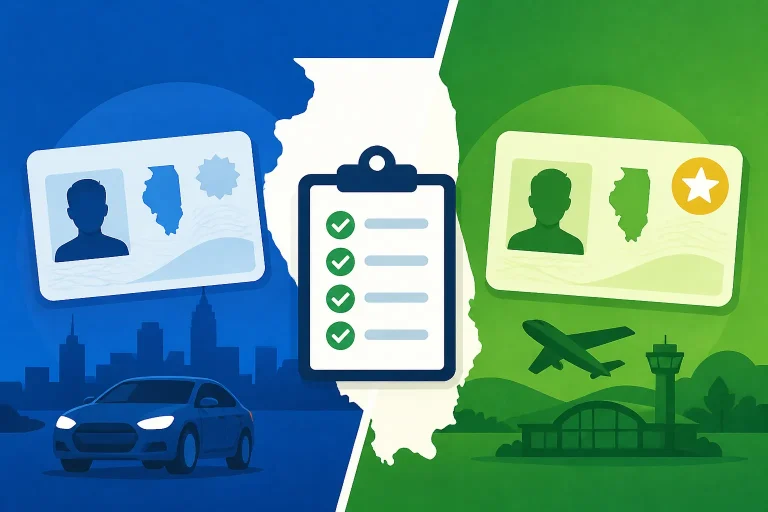
Applicants without an SSN still need to show that they meet the regular identity and residency documentation requirements that apply to their application. According to the Illinois Secretary of State, applicants for a VISA or NONVISA driver’s license or state ID are exempt from Group C document requirements provided they sign a specific declaration.
This is a limited exemption, not a general waiver of supporting documents. According to the Illinois Secretary of State, the applicant must bring documents proving identity, date of birth, lawful status, Illinois residency, and signature. Keep those categories in mind when gathering paperwork, and use the current official checklist to determine which specific documents are acceptable for your situation.
A practical way to prepare is to sort your papers by what each one is meant to prove. Some documents may support more than one part of an application, but do not assume that a particular item will be accepted for several categories unless the official requirements say so. The goal is to make it easy to show that each required element is covered.
You can use a simple preparation table:
| Requirement to cover | Preparation question |
|---|---|
| Identity | Which current document will establish who you are? |
| Date of birth | Which document will establish your birth date? |
| Lawful status | Which document will support the status information on your application? |
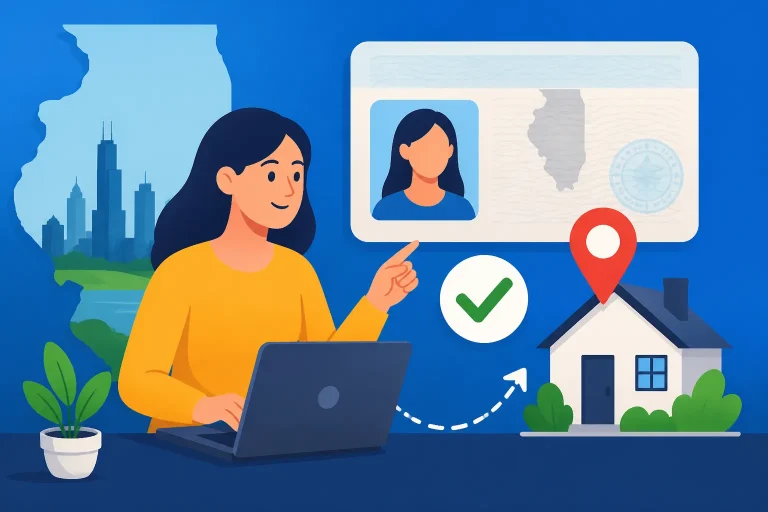
| Illinois residency | Which document or documents meet the current residency rules? |
| Signature | Which document provides an acceptable signature sample or record? |
| Group C exemption | Have you confirmed the declaration and how it must be completed? |
Do not treat the table as a substitute for the official document list. It is a way to check that you have considered each proof category before comparing your documents with the current requirements. For a closer look at document groups, see Bringing Group A, B, C, and D Documents to the Illinois DMV. For residency-specific questions, consult Acceptable Proof of Illinois Residency for a Driver’s License.
Keep original documents and any supporting paperwork together in a folder, and arrange them so you can find each category quickly. If a document is not in the format or condition the official checklist requires, it may not help establish the item you need. Check the current instructions rather than relying on an old checklist, a classmate’s paperwork, or a general online discussion.
Pay particular attention to names and other identifying details across your documents. If your documents show different versions of your name or other biographical information, ask the Secretary of State what supporting evidence is required before you go. Do not assume that a brief explanation will resolve a mismatch at the counter.
The Group C exemption is often the detail applicants focus on, but it is only one part of the application. The declaration does not replace proof of identity, lawful status, residency, or the other required categories. If you are preparing a state ID rather than a driver’s license, the exemption may also be relevant; confirm the applicable process with the Illinois Secretary of State.
Preparing and signing the declaration
The declaration is important because it communicates that you are ineligible for an SSN. According to the Illinois Secretary of State, applicants for a VISA or NONVISA driver’s license or state ID are exempt from Group C document requirements provided they sign a specific declaration. Treat it as a required part of the application when you are using this exemption, not as an optional note explaining that you do not have an SSN.
Before signing, make sure you understand what the declaration asks you to attest to. If you are not certain that the statement applies to you, pause and ask the agency for clarification. Signing a declaration because an SSN is inconvenient, delayed, or not currently available is not the same as confirming that you are ineligible. Be accurate about your situation and follow the official instructions.
A few preparation habits can make this part of the process clearer:
- Review the current instructions for the application you intend to make.
- Confirm whether you meet the ineligibility standard before relying on the exemption.
- Ask how the declaration is provided and completed; do not assume an old copy or an informal letter will be accepted.
- Check that the information you provide is consistent with your supporting documents.
- Bring the declaration as directed by the Secretary of State, along with the other required proof categories.
If you have a question about whether the declaration applies to your status, ask the Illinois Secretary of State before your visit. A school office or adviser may help you understand your own records, but the licensing agency determines what it accepts for the driver’s license application.
It is also sensible to keep a personal copy of the paperwork you submit, when permitted, and to make a note of any instructions the agency gives you. This can help you keep track of what you have already provided if the application needs follow-up. Do not alter or complete a form based on a friend’s interpretation; follow the current agency directions.
The declaration and the supporting documents work together. The declaration addresses the SSN document exemption; your other documents establish identity, date of birth, lawful status, Illinois residency, and signature. If any one of those categories is unclear, resolve it before you travel to a facility.
Planning the application and facility visit
Once you have confirmed that you are ineligible for an SSN and identified the right credential category, use the Illinois Secretary of State’s current instructions to prepare for the application. Requirements and procedures can change, so check the official information close to your planned visit rather than relying only on a saved copy or an informal checklist.
If an in-person visit is required for your situation, find a driver services facility and check its current services and hours with the official agency’s office locator. This site is an independent guide; applications, payments, tests, and document submissions are handled with the Illinois Secretary of State. Do not assume every facility provides every service.
Before leaving, review your paperwork as a complete application rather than as separate items. Check that you can produce proof for each required category, that you have followed the declaration instructions, and that you know which credential you are applying for. If you are unsure whether an original, copy, translation, or another format is acceptable, ask the agency rather than guessing.
A useful final review is:
- Eligibility: Have you confirmed that you are ineligible for an SSN, rather than simply not having one yet?
- Credential category: Have you confirmed whether the VISA or NONVISA route applies?
- Identity and status: Do you have the required proof for identity, date of birth, and lawful status?
- Residency and signature: Have you checked the current standards for Illinois residency and signature?
- Declaration: Have you followed the official directions for signing the specific declaration?
- Visit details: Have you checked the facility’s current services and hours using the official locator?
For general application documents, Illinois Driver’s License Document Checklist: Standard vs REAL ID can help you identify topics to verify, but the specific instructions for your situation take priority. If you need to know whether the application must be completed in person, see In-Person DMV Rule for First-Time Illinois Driver’s Licenses and confirm current requirements with the Secretary of State.
A license application may also involve testing or other steps depending on the applicant’s circumstances. Do not assume that the SSN exemption changes those requirements. The exemption concerns Group C document requirements; it does not establish that a test is waived or that every other part of the application is complete. For a general overview, see What Tests Are Required to Get Your First Illinois Driver’s License?. Confirm the steps that apply to you with the Illinois Secretary of State.
If you are studying for a knowledge test, an instructional resource such as I Drive Safely may be useful for practice, but it is not a substitute for official Illinois requirements or materials. Check the Secretary of State’s current study guidance, and do not treat a commercial study aid as a decision-maker for document eligibility.
Common mistakes to avoid
The most common confusion is equating “I do not have an SSN” with “I am ineligible for an SSN.” Those are not interchangeable statements. The exemption described by the Illinois Secretary of State is for applicants who are ineligible and who sign the required declaration. If your situation is temporary or unclear, confirm it before you apply.
Another avoidable mistake is preparing only the declaration. The exemption does not remove the need to prove the other required categories. An applicant who arrives with a declaration but lacks acceptable proof of residency or identity may still have an incomplete application. Use the current checklist to review the full set of requirements, not just the item that prompted your question.
Applicants can also get tripped up by relying on another student’s experience. A friend may have a different credential type, a different status, or a different document combination. Even if their application was accepted, that does not guarantee the same papers or process will work for you. Apply the official instructions to your own situation.
Avoid assuming that a campus office, private service, or driving school can approve the license application. These organizations may be able to help you organize questions or prepare for driving-related tests, but the Illinois Secretary of State handles the licensing decision and determines which documents meet the rules.
Finally, avoid waiting until you are at the facility to resolve basic uncertainties. If you are unsure about eligibility, the correct credential category, acceptable residency evidence, or the declaration, contact the official agency in advance. A little preparation can prevent a wasted trip and make it easier to respond if the agency asks for additional information.
For related licensing questions, Illinois Class D Driver’s License: Everyday Driving Rules and Classes explains the standard everyday-driving credential, while Getting an Illinois Instruction Permit as a First-Time Driver covers a different stage of the licensing process. Those topics can help you plan, but they do not replace the document rules for an applicant using the SSN exemption.
Frequently Asked Questions
Can an international student apply if they do not have an SSN?
Possibly, if the student is ineligible for an SSN and meets the other application requirements. According to the Illinois Secretary of State, an eligible international student may apply for an Illinois VISA or NONVISA driver’s license. Confirm your eligibility rather than assuming that not having an SSN is enough.
Does the exemption mean I bring no Social Security documents?
The Illinois Secretary of State says applicants who qualify for the exemption do not need a Group C Social Security document, provided they sign a specific declaration. Other required proof categories still apply.
Can I use the same exemption for a state ID?
According to the Illinois Secretary of State, applicants for a VISA or NONVISA driver’s license or state ID are exempt from Group C document requirements provided they sign a specific declaration. Check the agency’s current state ID instructions for the rest of the application requirements.
Which documents should I bring?
Prepare documents proving identity, date of birth, lawful status, Illinois residency, and signature, and follow the current official checklist for acceptable documents. Ask the Illinois Secretary of State if you are unsure whether a particular document qualifies.
Sources
- Illinois Secretary of State — Document Requirements to Obtain a Driverʼs License or State ID Card (checked November 11, 2026)
Disclaimer
This article is for general informational purposes only and does not constitute professional advice. Laws, prices and regulations vary by location and change over time. Consult a qualified professional for guidance on your specific situation. Illinois Driver Guide is not a government agency and is not affiliated with any state motor vehicle department.