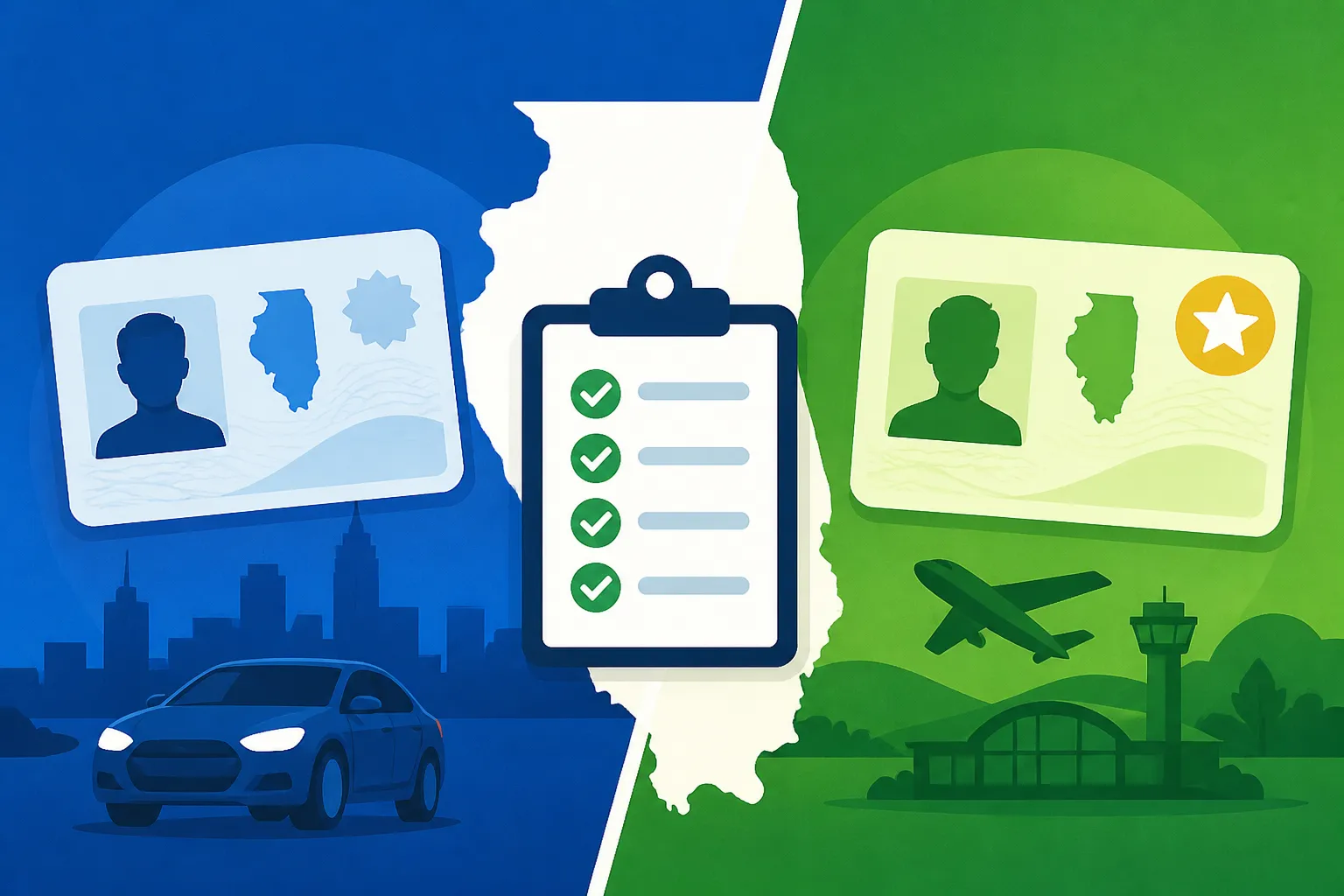
Illinois Driver’s License Document Checklist: Standard vs REAL ID
Choosing between a standard Illinois driver’s license and a REAL ID is only part of the task: you also need to assemble the right documents for the card you want. The requirements differ, and a prior standard card does not remove the REAL ID document rules. Use this checklist to identify the right path, organize your paperwork, and confirm details with the Illinois Secretary of State before your visit.
Start by choosing the card you are applying for
The document checklist depends on whether you are requesting a standard Illinois driver’s license or a REAL ID. Begin by deciding which card you want, then use the corresponding document list from the Illinois Secretary of State. Do not build a single collection of papers and assume it will satisfy both sets of requirements.
According to the Illinois Secretary of State, first-time applicants for a standard Illinois driver’s license or state ID card must submit one document from each specified group. First-time REAL ID applicants must present documents covering Groups A, B, and C, plus two residency documents. The agency also says that the REAL ID document requirements apply even if you currently hold, or previously held, a standard Illinois license or ID card.
Those rules make the choice practical, not just a matter of card appearance. The card type determines which document categories you need to cover. Because the list of accepted documents and group assignments matters, check the official checklist for the exact application you plan to make before gathering paperwork.
| Your application | Document framework to plan around | Key point |
|---|---|---|
| First-time standard Illinois driver’s license | One document from each group specified for the standard application | Follow the standard document list, not the REAL ID list |
| First-time standard Illinois state ID card | One document from each group specified for the standard application | The stated standard rule covers licenses and state ID cards |
| First-time Illinois REAL ID | Documents covering Groups A, B, and C, plus two residency documents | A previous standard card does not waive these requirements |
This comparison summarizes the rules, but it is not a substitute for the Secretary of State’s detailed list of accepted documents. A document’s name, condition, and exact category can matter. If you are unsure whether a paper qualifies, check the official instructions rather than relying on its everyday description.
It can help to keep two questions separate:
- Which card are you applying for? This determines which document framework to follow.
- Which documents are accepted in the required groups? The official list answers this; do not assume a document fits a group because it seems relevant.
If you are still deciding between card types, Illinois Driver’s License Markings: REAL ID vs Standard Card and Does Your Illinois License Meet Federal REAL ID Standards? may help you understand the difference between the cards. Then return to the relevant application checklist before collecting documents.
Standard Illinois license checklist
For a first-time standard Illinois driver’s license or state ID card, the central task is to provide one document from each group specified for that application. The phrase “each specified group” is important: it means you should use the official standard checklist to identify the groups and accepted documents that apply. Do not assume the standard application uses the same categories or evidence as a REAL ID application.
Build the checklist from the official group list
Start with the standard application’s current document list from the Illinois Secretary of State. Write down every group shown for your specific application, then choose an accepted document for each group. Check the list against the type of credential you are requesting; a driver’s license and a state ID card are both covered by the stated standard rule, but your application still needs to match the service you want.
A useful working checklist looks like this:
- Confirm that you are following the standard application instructions.
- Copy the group names shown on the official checklist.
- Select one document listed as acceptable for each specified group.
- Compare the document details with the official requirements.
- Keep the documents organized by group so you can verify coverage before leaving.
This is a planning method, not an alternative document list. The exact accepted papers are determined by the Secretary of State, not by whether an item seems like strong proof in ordinary circumstances. For instance, a document that identifies you or shows where you live should not automatically be treated as acceptable for a particular group unless the official list assigns it there.
If you want a broader explanation of Illinois document categories, see Bringing Group A, B, C, and D Documents to the Illinois DMV. For residency evidence, Acceptable Proof of Illinois Residency for a Driver’s License can provide related context. Still, use the document requirements for your actual application as the final check.
Keep the standard and REAL ID lists distinct
A common planning mistake is to prepare for a standard card and then decide to request REAL ID at the counter without checking whether the documents cover the REAL ID categories. The two frameworks are not interchangeable. A packet that appears complete for a standard application may not cover the requirements for a REAL ID application.
If you might want REAL ID, decide before gathering documents and use that card’s list from the beginning. That gives you a chance to confirm the required categories and residency documents in one pass. If you decide to stay with a standard card, use the standard list rather than adding documents solely because they appear on a different checklist.
This distinction also matters for people replacing, correcting, or renewing a card. The facts here describe first-time applications and do not establish that every service uses the same evidence rules. Check the instructions for the exact transaction rather than assuming a checklist for an initial application applies to every later visit. Related reading includes Illinois Driver’s License Renewals, Validity, and Card Term Guide and When You Must Visit an Illinois DMV Facility Instead of Going Online.
Do not guess which document belongs in a group
A document can be genuine and useful yet still fail to meet the particular category requested. The safest approach is to match each item to the Secretary of State’s accepted-document list, not to decide based on the document’s title alone.
If an item has several pages, a variation in name, or information that does not match your application, check the official instructions for that detail. If the list does not clearly answer your question, seek clarification from the Secretary of State before relying on the item. Bringing a substitute without confirming it may leave a required group uncovered.
REAL ID checklist
A first-time Illinois REAL ID application has a specific framework. According to the Illinois Secretary of State, applicants must present documents covering Groups A, B, and C, plus two residency documents. The agency says these requirements apply even to a person who currently holds or previously held a standard Illinois driver’s license or state ID card.
That means a standard card is not, by itself, a reason to skip the REAL ID document check. If you are applying for REAL ID for the first time, use the REAL ID checklist and confirm each required category. Do not assume that documents presented for a prior standard card application will automatically cover the current REAL ID requirements.
Organize by category, not by document pile
For planning, make a separate line for each required category:
- Group A
- Group B
- Group C
- Residency documents
Then use the official REAL ID list to select documents accepted for those categories. The residency part is distinct in the stated rule: the applicant needs two residency documents in addition to documents covering Groups A, B, and C.
Keep the category labels with your notes, but do not write your own interpretation of what qualifies. Copy the names of documents from the official list and check each item against its stated category. That reduces the risk of bringing papers that appear relevant but do not satisfy the requested group.
Treat prior standard-card paperwork as background, not a waiver
Having a standard Illinois license or state ID may make the process feel familiar, but it does not remove the REAL ID document requirements described by the Secretary of State. The key question is not whether you have shown documents to the agency before. It is whether the documents you plan to present meet the required categories for this REAL ID application.
You can use your existing card as a personal reference when organizing your application, but do not count it as satisfying a category unless the current official checklist says it qualifies. The same caution applies to an old application record, an appointment confirmation, or a memory of what was accepted previously. The current application requirements are the ones to verify.
If your earlier card was REAL ID, or if you are not sure which kind of card you have, confirm the card type rather than guessing from appearance. Standard vs REAL ID in Illinois: Checking Your Card Type covers that question. For a replacement or update, review the instructions for that particular service as well; a first-time REAL ID checklist should not be assumed to cover every transaction.
Confirm the residency documents separately
The REAL ID framework specifically calls for two residency documents. Review the official residency list carefully, and confirm that the documents you select are acceptable for that purpose. Do not assume that a single document can serve as both residency documents, or that any address-bearing paper counts, unless the Secretary of State’s instructions explicitly support that interpretation.
Check the address information on each proposed residency document. If it differs from the information you expect to use for the application, do not assume the difference is harmless. The official instructions may explain what is accepted or what to do when records do not match. When the answer is unclear, ask the agency before relying on the document.
For related guidance, see What Documents Count for Illinois Residency on License Applications? and Updating Your Illinois Address: Is a New Physical Card Required?. These topics can help you think through address-related questions, but the checklist for your REAL ID application remains the deciding reference.
How to assemble and check your documents
Once you know which card you want, document preparation is mostly a matter of careful matching. You are not simply collecting as many papers as possible. You are checking that your selected documents correspond to every required category for the application you plan to make.
Make a document map
Create a simple table or written list before setting papers aside. For a standard application, include each group shown in the official standard checklist. For a REAL ID application, list Groups A, B, and C, and make a separate entry for the two residency documents. Add the name of the document you intend to use beside each category.
This document map helps reveal gaps. If a group has no document beside it, you know what still needs attention. If one document is listed more than once, verify with the Secretary of State whether it can be used for more than one requirement. Do not assume that one item can satisfy multiple groups simply because it contains several kinds of information.
Keep the map as a planning aid, not as a replacement for the documents themselves. The agency evaluates the actual items under its rules. Your notes only help you organize the packet and spot uncertainty before the visit.
Check the details on each document
Compare each document with the official requirements, paying attention to the exact document type and the information shown. If your name, address, or other identifying details vary across documents, check the instructions rather than deciding on your own that the difference will be accepted.
Do not alter a document or rely on a handwritten explanation to make it fit a category. If you have a mismatch, find out what the agency accepts for that situation. A discrepancy may be easy to resolve, but it is better to identify it before you arrive than to discover that a document does not meet the checklist.
Keep the packet easy to review
Place the documents in an order that follows the official categories. You might use separate folders or paper clips to keep groups distinct, provided you do not mark, cover, or change the documents themselves. Keep your checklist nearby so you can verify that each item is present.
If you are applying for REAL ID, make the residency documents easy to distinguish from the documents assigned to Groups A, B, and C. If you are applying for a standard card, label the groups used in the standard application instead. Clear organization will not change eligibility, but it can make it easier for you to notice a missing category.
Before the visit, review the packet from the beginning as if you were checking it for the first time. Ask whether every required group has a document, whether the residency documents are included when required, and whether you have confirmed that every item is accepted for the application type. If any answer is uncertain, resolve it with the Secretary of State before making the trip.
Situations that often cause confusion
Some applicants know what card they want but are unsure how their history affects the document rules. The safest approach is to use the requirements for the transaction you are making and avoid treating a past application as proof that current requirements are already satisfied.
You already have a standard Illinois card
A standard Illinois license or ID card does not remove the document requirements for a first-time REAL ID application. According to the Illinois Secretary of State, the REAL ID document rules apply even if you currently hold or previously held a standard Illinois driver’s license or ID card.
Use the REAL ID checklist and assemble the required documents anew for that application. You may remember what you brought for the standard card, but that memory does not establish that the same packet covers Groups A, B, and C and the residency requirement. Verify each category against the official list.
You are applying for a state ID rather than a driver’s license
The stated standard-document rule covers first-time applicants for either a standard Illinois driver’s license or a standard state ID card. If you want an ID card rather than driving privileges, make sure you are using the instructions for that credential and the card type you intend to request.
If you are weighing which credential fits your situation, Illinois State ID vs Driver’s License: Deciding Which Card to Get may help you frame the choice. Do not confuse the credential decision with the document decision: first identify the card type, then follow the matching document checklist.
You have held a card before but are applying for REAL ID
The Secretary of State’s stated rule addresses this directly: prior or current ownership of a standard card does not exempt a first-time REAL ID applicant from REAL ID document requirements. This can surprise people who expect the agency to rely on documents already presented for a standard card.
Treat the REAL ID application as a separate document-planning task. Check the required groups and residency documents, and make sure your planned documents are accepted under the current instructions. If the service you need is not a first-time REAL ID application, check the specific instructions for that service instead of extending the first-time rule beyond what it says.
You are changing or correcting information
An address change, name change, replacement, renewal, or other correction can involve a different transaction from a first-time application. The requirements in this checklist should not be treated as a complete rule for every type of update. Identify the exact service and review its document instructions.
For an address change, How to Change Your Address on an Illinois Driver’s License Online and Getting a Corrected Illinois Driver’s License With Your New Address may be useful starting points. For a name update, see Documents Needed to Change Your Name on an Illinois Driver’s License. Use those topics to orient your planning, then confirm the agency’s instructions for the exact action you need.
You are uncertain whether your documents qualify
If a document is not clearly listed, do not rely on a similar-sounding category or an informal interpretation. Check the Secretary of State’s accepted-document instructions. If you still cannot tell, contact the agency or use its official service information to ask what applies to your circumstances.
It is especially important to confirm unclear cases before traveling to a facility. That includes documents with conflicting personal information, documents you are unsure how to categorize, and any proposed item you hope to use for more than one requirement. A quick clarification can prevent a visit that ends with an incomplete application.
Plan the facility visit around the application
After preparing the documents, confirm the practical details for the service you need. Check the Illinois Secretary of State’s official information for current facility services, appointment requirements, and other visit instructions. Do not assume that every facility offers every service or that a visit requirement is the same for every application.
Use the official facility locator to find a nearby office and check its current hours. This guide does not provide office addresses or hours because those details can change. If an appointment is relevant to your service, confirm the current process with the Secretary of State.
Before leaving, run through this final review:
- You have selected standard or REAL ID and are following that application’s checklist.
- Every group specified for the standard application has a document, or the REAL ID packet covers Groups A, B, and C.
- The REAL ID packet includes two residency documents.
- You have checked every proposed document against the official accepted-document list.
- You have addressed any differences in names, addresses, or other details.
- You have confirmed the facility and visit instructions for the service you need.
For additional visit planning, Planning Your Illinois Driver Facility Visit: Complete Guide and Illinois DMV Paperwork: What You Must Bring and What You Leave With can help you prepare. For a broader overview of licensing steps, see Driver’s License Handbook: Renewals, REAL ID, and Testing Steps.
A well-organized packet cannot guarantee that every document will be accepted, because the Secretary of State applies its official document rules. But choosing the right checklist, matching each item to its stated group, and resolving uncertainties in advance gives you a clearer and more reliable plan.
Frequently Asked Questions
Does a standard Illinois license meet the document requirements for REAL ID?
A standard card does not waive the REAL ID requirements for a first-time REAL ID application. According to the Illinois Secretary of State, those applicants must present documents covering Groups A, B, and C, plus two residency documents.
How many documents are needed for a first-time standard Illinois license?
According to the Illinois Secretary of State, a first-time standard license or state ID applicant must submit one document from each group specified for that application. Check the official standard checklist to identify those groups and accepted documents.
Do the same documents work for standard and REAL ID applications?
Do not assume they do. The two application types have different stated document frameworks. Match your documents to the official list for the card you are requesting.
Can a document satisfy more than one required category?
Do not assume that it can. Check the Secretary of State’s instructions for the exact document and categories, or ask the agency if the official list does not make the answer clear.
Sources
- Illinois Secretary of State — Document Requirements To Obtain Drivers License Or State Id Card (checked November 11, 2026)
Disclaimer
This article is for general informational purposes only and does not constitute professional advice. Laws, prices and regulations vary by location and change over time. Consult a qualified professional for guidance on your specific situation. Illinois Driver Guide is not a government agency and is not affiliated with any state motor vehicle department.