Illinois Class D Driver’s License: Everyday Driving Rules and Classes
An Illinois Class D license is the everyday credential for driving a car, but it does not authorize every vehicle or erase rules that apply to new drivers. The class you need depends on the vehicle, while age-based limits, traffic laws, and required documents affect how you drive. Here’s how to tell what Class D covers and where its boundaries are.
What an Illinois Class D license means
A driver’s license class identifies the types of vehicles you’re authorized to operate. In Illinois, Class D is the ordinary license class for many personal vehicles, including passenger cars and light trucks. It is not a commercial license and does not include motorcycle privileges.
The practical question is not just whether a vehicle looks like a car or truck. Its weight rating, passenger capacity, intended use, and equipment can matter. A large truck, a bus, a vehicle carrying certain hazardous materials, or a motorcycle may require a different class or qualification.
For a typical driver using a personal sedan, SUV, minivan, or light pickup, Class D is generally the relevant class. Still, check the vehicle’s ratings and purpose before driving something unfamiliar, especially a large rental truck or a vehicle used for work. The manufacturer’s label and vehicle documents can help identify weight ratings; the Illinois Secretary of State can clarify which license class applies.
Class D is also separate from whether a vehicle is legally registered, insured, or safe to drive. A valid license does not replace those requirements. Likewise, having the correct license class does not give a driver permission to ignore restrictions attached to a permit, a young driver’s license, or a court order.
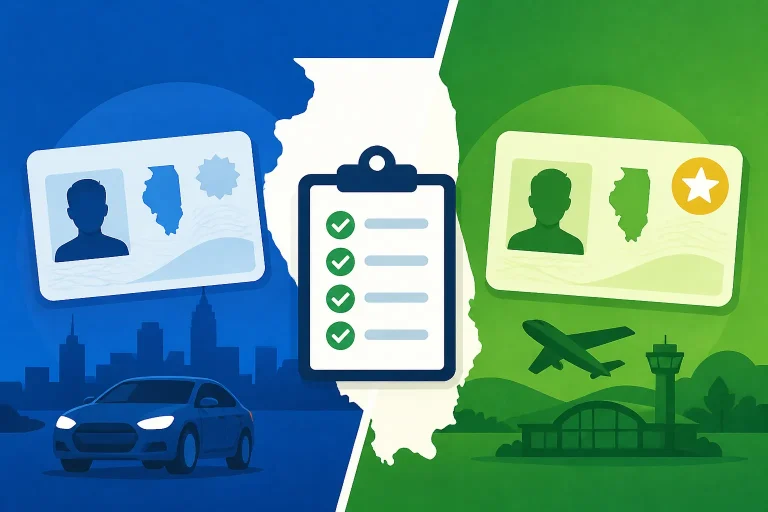
If you’re trying to identify the class printed on your card or understand other card markings, see Illinois Driver’s License Markings: REAL ID vs Standard Card. REAL ID or standard status describes identification use and federal standards, not the vehicles the license lets you drive.
Which vehicles Class D covers and where the limits are
For everyday use, Class D commonly covers passenger cars and light vehicles that do not fall into a category requiring a commercial or motorcycle license. The key is to avoid assuming that a vehicle is covered solely because it is used for personal transportation.
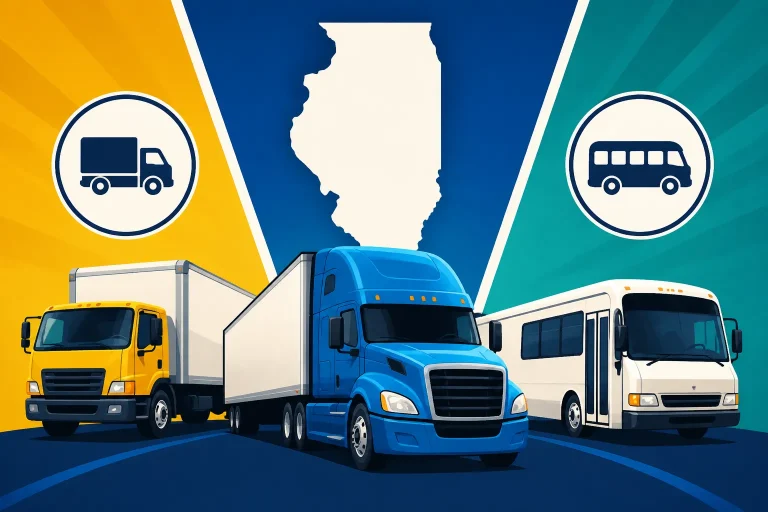
Illinois has other classes for vehicles that require specialized driving privileges. Commercial classes can apply based on vehicle weight, combinations of vehicles, passenger capacity, or hazardous-materials requirements. Motorcycle classes are separate. Some vehicles may also call for an endorsement or other qualification in addition to the underlying license.
| Vehicle or situation | What to check |
|---|---|
| Personal sedan, SUV, or minivan | Whether it is an ordinary passenger vehicle and whether you have any age-based or license-specific restrictions |
| Light pickup or small personal truck | The vehicle’s weight rating and whether its use or equipment changes the license requirement |
| Large truck or combination vehicle | Weight ratings, towing capacity, and whether a commercial class is required |
| Bus or passenger-carrying vehicle | Seating capacity, vehicle use, and any commercial or passenger qualification |
| Vehicle carrying regulated hazardous materials | Whether a commercial class and hazardous-materials qualification are required |
| Motorcycle or motor-driven cycle | Whether a motorcycle class or other specific privilege is required |
| Rental vehicle | The rental company’s terms, vehicle ratings, and the license class required for that vehicle |
The table is a screening tool, not a substitute for checking a specific vehicle. A pickup can be light enough for ordinary use, while another truck that looks similar may exceed a relevant limit. Towing a trailer can also change the combination’s weight and the license class needed. When in doubt, review the vehicle’s specifications and ask the Illinois Secretary of State what class applies before driving.
Commercial driving rules can be more complex than a vehicle’s appearance suggests. A vehicle might require commercial licensing because of its weight or because it transports passengers or regulated cargo, even if it is not a tractor-trailer. For a closer look at the commercial categories, see Commercial Driver’s License Classes in Illinois: Class A, B, or C? and CDL Class Guide: Commercial Vehicles, Tests, and SOS Endorsements.
A motorcycle is not an extension of Class D. If you plan to ride one, check the separate motorcycle classifications and testing requirements in Class L vs Class M in Illinois: Engine Size Differences. Do not assume that a standard car license covers a two-wheeled vehicle.
Class D is not the same as permission for every use
The license class answers a limited question: what types of vehicles can you operate under that credential? It does not necessarily settle whether you may use a vehicle for a particular job, carry a particular load, or drive under a special restriction.
For example, commercial transportation can involve rules beyond the license class, and some employers or rental companies may set their own requirements. A driver with a Class D license should not accept a task involving a bus, large truck, or regulated cargo without confirming that the vehicle and use are allowed.
How Class D differs from other Illinois license classes
The most useful way to understand the classes is to match them to the vehicle—not to treat them as levels of an ordinary car license. Class D is the familiar everyday class; commercial and motorcycle classes cover different vehicle types or operations.
| License class | General role | Typical reason to check it |
|---|---|---|
| Class D | Everyday driving in many passenger cars and light vehicles | Personal car, SUV, minivan, or qualifying light truck |
| Class A | Certain heavy combination vehicles | A combination such as a large truck towing a substantial trailer |
| Class B | Certain heavy single vehicles | A heavy straight truck or other qualifying single vehicle |
| Class C | Certain vehicles that do not fall under Class A or B but meet commercial criteria | A vehicle that meets a weight, passenger, or hazardous-materials trigger |
| Class L or M | Motorcycle privileges | Riding a motorcycle or other vehicle covered by the applicable class |
This is a broad orientation, not a complete legal classification chart. The vehicle’s exact weight ratings, configuration, passenger design, cargo, and use can change the answer. Check the official Illinois requirements before operating a vehicle that may fall outside ordinary passenger use.
A common misunderstanding is that Class D is a general-purpose license with no vehicle ceiling. It is not. A driver may have years of experience and still need a different class to operate a vehicle that crosses a licensing threshold. Conversely, a vehicle that looks substantial may still be covered by an ordinary license if it meets the applicable requirements. Confirm the details rather than guessing from size.
Another common mix-up is between a license class and a card type. Standard and REAL ID credentials concern identification and federal acceptance; the driving class is a separate matter. The card’s design does not by itself tell you whether you may operate a commercial vehicle or motorcycle. If you are comparing card types, Illinois Driver’s License Document Checklist: Standard vs REAL ID explains the documents involved.
Endorsements and restrictions also matter. An endorsement can add a specific privilege, while a restriction can narrow how a person may drive. A medical or corrective-lens restriction, for example, is different from a vehicle class. Read the card carefully and follow any notation that applies to you. For special markings, Driver Cards: Medical Codes, Disabilities, and Special Markings covers how card notations can affect driving.
Everyday driving rules that apply to Class D drivers
Class D describes a license category; it is not a separate set of road rules. Drivers must follow the rules that apply to their age, license status, vehicle, and circumstances. That includes obeying signs and signals, driving at a safe speed, yielding when required, using seat belts, and avoiding impaired or distracted driving.
Keep your license and driving status valid
Drive only when your license is valid and any restrictions are satisfied. If your card is expired, suspended, revoked, or otherwise restricted, the fact that you once qualified for Class D does not make driving lawful. Check your record if you have received a suspension notice, missed a court requirement, or are uncertain about your status. Checking Your Illinois Driver’s License Status and Driving Record explains what to review.
Keep the physical card accessible while driving and be prepared to show it when lawfully requested. If you move, update your address with the Illinois Secretary of State within the required period. The address on a card is not just a mailing preference; keeping records current can help avoid missed notices and problems with future transactions. See How to Change Your Address on an Illinois Driver’s License Online for the address-update process.
If your card is lost, damaged, or stolen, use the official Secretary of State process to replace it. Avoid driving on the assumption that a photo or a copy of an old card is automatically an acceptable substitute. Replacement steps are covered in Replacing a Lost or Damaged Illinois Driver’s License Online.
Follow the rules for speed, signals, and right of way
A Class D driver must obey posted speed limits and adjust speed for conditions. A posted limit does not mean that speed is safe in heavy rain, snow, low visibility, congestion, or near people walking and cycling. Leave room to stop and reduce speed when conditions make it harder to see or react.
Traffic controls and right-of-way rules apply even when an intersection seems empty. Stop fully where required, yield to the road users who have priority, and do not enter an intersection unless there is room to clear it. At a merge, work zone, or lane closure, follow signs and markings and avoid forcing other drivers to brake suddenly.
Passing rules deserve care, too. Do not pass where prohibited, near a crest or curve with limited visibility, or when the maneuver would put another road user at risk. Move over or slow down where required for stopped emergency or service vehicles. A Class D credential offers no exception to these rules.
Avoid impairment and distraction
Do not drive while impaired by alcohol, drugs, medication, or any other condition that affects safe control. A substance can interfere with judgment and reaction time even if a driver feels capable. If a prescription or over-the-counter medicine may cause drowsiness or impaired coordination, read its warnings and arrange another way to travel if needed.
Illinois restricts the use of handheld electronic devices while driving, with limited exceptions. The safest habit is to set navigation and music before moving, silence notifications, and pull over legally before handling a phone. Hands-free use does not make every conversation safe; if traffic or weather needs your attention, end the call.
New drivers should pay particular attention to passenger and nighttime limits. Those are not universal Class D rules for every adult; they are part of the restrictions that can apply during Illinois’s graduated licensing stages. The details are in Illinois Teen Graduated Licensing Rules: Night and Passenger Limits.
Use seat belts and secure passengers
Drivers and passengers must follow seat-belt requirements. The driver is responsible for safe operation, and children need the appropriate restraint for their age and size. Use the correct child safety seat or booster as required, install it according to its instructions, and check that it is secured properly. A restraint that is present but used incorrectly may not protect a child as intended.
Before moving, make sure every passenger is seated in an appropriate place and wearing the required restraint. Do not let passengers ride in unsafe cargo areas or exceed the vehicle’s designed seating capacity. A Class D license does not authorize carrying more people than the vehicle is designed and equipped to transport.
Carry the required insurance and keep the vehicle roadworthy
Drivers must comply with Illinois’s financial responsibility and insurance requirements. Confirm that the vehicle has the required coverage before driving, including when borrowing a car or using a vehicle owned by someone else. Do not assume that a vehicle is insured merely because it has a current plate sticker or the owner says it is covered.
Check basic safety items before a trip: tires, lights, mirrors, windshield visibility, brakes, and required restraints. Remove snow or ice that blocks visibility, and secure cargo so it cannot shift or fall. These checks matter for every Class D driver, whether the trip is a quick errand or a long drive.
Rules that can apply to teen and first-time drivers
A newly issued Class D license does not always mean a young driver has the same privileges as an experienced adult. Illinois uses graduated licensing requirements for teens, with stages and restrictions that depend on age and licensing history. The limits can involve supervision during the permit phase, nighttime driving, passengers, and consequences for violations.
The driver’s age and stage matter more than the words “Class D” alone. A teen may have a credential that allows driving independently but still be subject to passenger or nighttime restrictions. A parent or guardian should not assume that the rules end as soon as the road test is passed. Check the current restrictions and note when each one ends.
For the permit stage, teens must meet supervised practice requirements and follow the rules for who may supervise. A permit is not an unrestricted license: the required adult must be present, and the teen must follow permit conditions. Illinois Learner’s Permit Rules: 50 Supervised Hours and Curfews explains the practice and curfew rules, while Who Can Supervise an Illinois Teen’s 50 Practice Driving Hours? focuses on the supervising driver.
Teens and families should also keep track of driver education, permit time, and required documentation. A missing record or incomplete requirement can delay the next licensing step. Before a first license appointment, use Checklist for a Teen’s First Illinois Driver’s License Appointment to organize what to bring.
A violation can have consequences beyond a ticket. It may extend a restriction, affect eligibility for the next stage, or lead to a suspension, depending on the circumstances and applicable rules. If a teen receives a citation or notice, read it promptly and follow the directions from the court or agency involved. Do not rely on informal assumptions about whether the matter affects a license.
Parents can make the rules easier to follow by setting clear household expectations. Keep a copy of applicable restrictions, agree on who may ride in the car, and decide how the teen will handle phone calls, bad weather, and late-night plans. These are practical safety measures, not replacements for the legal requirements.
Getting a Class D license and preparing to drive
The steps depend on your age and driving history. A first-time applicant generally needs to satisfy identity and residency requirements, complete any required education or practice, pass applicable screening and exams, and complete the transaction with the Illinois Secretary of State. A transfer from another jurisdiction, a renewal, and an initial license are different situations, so identify yours before gathering paperwork.
Start with the right application path
If you are a new Illinois resident with a valid license from elsewhere, the transfer process may differ from a first-time application. If you have never held a license, you may need an instruction permit and required testing. If your license is close to expiration, a renewal process may apply instead. For a new resident, Transferring Your Out-of-State License to Illinois: Complete Checklist outlines the transfer questions to resolve.
Do not assume that every service can be completed online. Some applicants must visit a driver services facility for identity checks, testing, a photo, or other steps. Use the Illinois Secretary of State’s official service information to determine whether your transaction requires an in-person visit and what documents to bring. Online vs In-Person Driver’s License Services in Illinois can help you sort out which route may apply.
Organize documents before you go
The documents needed depend on the transaction and the type of credential. Applicants may need evidence of identity, date of birth, Social Security number or applicable alternative documentation, and Illinois residency. REAL ID applications have their own document standards. Use the specific checklist for your situation instead of bringing only the documents that worked for someone else.
For a standard-versus-REAL ID comparison, see Illinois Driver’s License Document Checklist: Standard vs REAL ID. For an address or residency question, Acceptable Proof of Illinois Residency for a Driver’s License provides more detail. Confirm the current list with the Illinois Secretary of State before traveling, because incomplete paperwork can mean a second visit.
Find the nearest facility and its current hours using the official agency’s office locator. Check whether appointments are needed for the service you plan to complete. Do not assume that every facility offers every test or transaction.
Prepare for screening and exams
First-time drivers may need vision screening, a knowledge exam, and a road test, depending on their circumstances. A transfer applicant or renewal customer may face different requirements. Review the official Rules of the Road and focus on signs, right-of-way, safe following distance, speed choices, and other rules that apply in daily driving.
A private study resource such as I Drive Safely may be useful as a supplement for some learners, but it does not replace official requirements or prove that a particular course satisfies a state requirement. Before paying for a course, confirm that it applies to your exact situation. For preparation options, see How to Study for the Illinois Driver’s License Written Exam.
For a road test, arrive with a vehicle that is eligible and in safe working order. Check required equipment, registration, and insurance in advance. Make sure you understand who must accompany you and what documents are required for your specific appointment. Preparing for an Illinois Driving Test Practice Exam After Failing is helpful if you need to review after an unsuccessful attempt.
Know what happens after issuance
A temporary document may be provided while a permanent card is produced or mailed. Follow the instructions on any temporary credential and do not assume it grants privileges beyond those stated. If a permanent card does not arrive within the expected period, check its status through the official Secretary of State process. How Long Does It Take for a Permanent Illinois License to Arrive? explains what to do if delivery is delayed.
After receiving your license, check the printed information for accuracy. Review the class, expiration date, restrictions, and any endorsements. If something is wrong, contact the Illinois Secretary of State about a correction rather than waiting until a later renewal.
Choosing the right next step for your situation
Use the Class D label as a starting point, then check the circumstances that can change what you are allowed to do. These questions help prevent the most common mistakes:
- What vehicle will you drive? Confirm its weight rating, configuration, passenger capacity, and whether it carries regulated cargo.
- Is it a motorcycle or commercial vehicle? If so, check the applicable class, endorsement, and testing rules instead of relying on Class D.
- Are you subject to age-based limits? Teens and some new drivers can have restrictions even when they hold a license.
- Is your license valid and unrestricted for this trip? Check expiration, suspension status, and any conditions printed on the card.
- Is the vehicle legal to use? Confirm insurance, registration, and basic safety before driving.
- Are you prepared for the conditions? Adjust speed, visibility, following distance, and route to the weather and traffic.
If you are borrowing a vehicle, ask the owner for the vehicle details rather than guessing. If you are renting, tell the rental company what class of license you hold and confirm the vehicle is appropriate. If an employer asks you to drive a vehicle beyond ordinary passenger use, verify the requirement before accepting the task.
The same approach works when buying a vehicle. Read the manufacturer’s weight information, ask whether towing changes the licensing requirement, and check whether the intended use triggers commercial rules. It is much easier to confirm the right class before a trip than to discover a problem at the roadside or after an incident.
A Class D license is designed for ordinary driving, but being licensed is only one part of driving legally. Keep the credential current, follow any restrictions, operate only vehicles the class covers, and treat insurance and roadworthiness as separate responsibilities. When a vehicle falls near a classification threshold, seek a definitive answer from the Illinois Secretary of State before taking the wheel.
Frequently Asked Questions
Does an Illinois Class D license let me drive any car?
It covers many ordinary passenger vehicles and light vehicles, but not every vehicle. Weight, configuration, passenger capacity, cargo, or vehicle use can require another class or qualification. Check the specific vehicle before driving it.
Does Class D include motorcycle privileges?
No. Motorcycle operation requires the applicable motorcycle class. Check the rules for the motorcycle you intend to ride.
Does a Class D license remove teen driving restrictions?
No. A teen driver may still have graduated licensing restrictions based on age and licensing stage. Follow the restrictions that apply to the driver, even after receiving a license.
Is a REAL ID a different driving class?
No. REAL ID describes a credential’s identification status. It does not change the vehicle class printed on the license or add commercial or motorcycle privileges.
Where should I confirm which license class a vehicle requires?
Check the vehicle’s specifications and the Illinois Secretary of State’s official requirements. For vehicles involving heavy weight, towing, passengers, or regulated cargo, confirm the classification before driving.
Disclaimer
This article is for general informational purposes only and does not constitute professional advice. Laws, prices and regulations vary by location and change over time. Consult a qualified professional for guidance on your specific situation. Illinois Driver Guide is not a government agency and is not affiliated with any state motor vehicle department.