Transferring Your Out-of-State License to Illinois: Complete Checklist
Moving to Illinois brings a practical driving question: how do you switch an out-of-state license, what should you bring, and do you need to take an exam? The answer depends partly on whether your current license is valid and whether you want a standard credential or REAL ID. Use this checklist to prepare for the required in-person visit and avoid preventable delays.
Start With the Deadline and the In-Person Requirement
According to the Illinois Secretary of State, a person moving to Illinois from another state has 90 days to obtain an Illinois driver’s license or state ID. That deadline is the key starting point: plan the transfer soon after you become an Illinois resident rather than waiting until your old card is close to expiring.
New residents cannot complete the application online. According to the Illinois Secretary of State, new residents applying for an Illinois driver’s license or ID must do so in person at a DMV. You will need to find an appropriate Driver Services facility through the official agency’s facility locator, check its current services and requirements, and complete the application there.
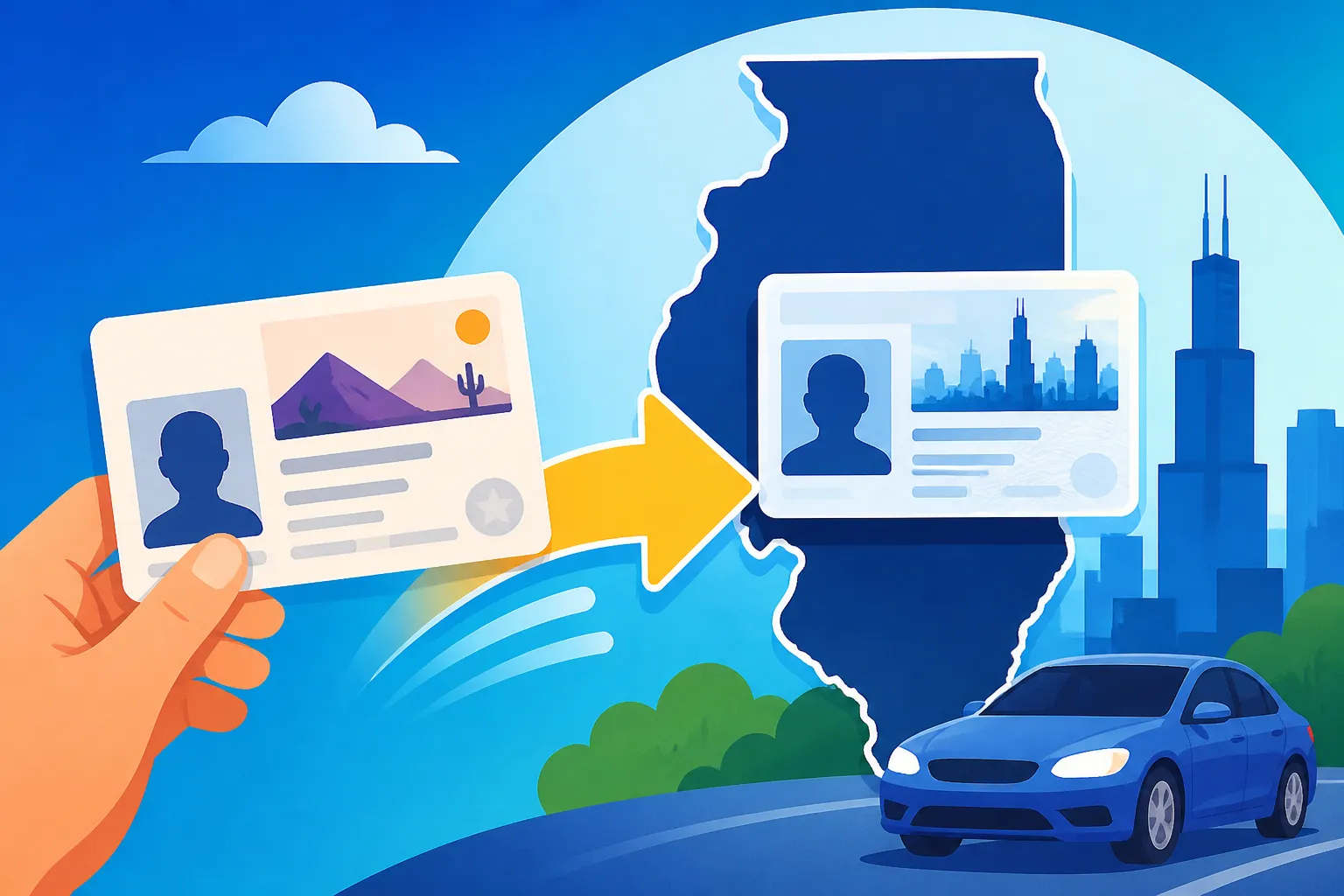
This is a transfer process, not simply an address change on your old credential. You will apply for an Illinois card, meet the document requirements for the card type you choose, complete any required screening, and surrender your out-of-state credentials before receiving the Illinois credential. The Illinois Secretary of State requires new residents to “surrender all out-of-state driver’s licenses and identification cards” before receiving an Illinois license or state ID.
That surrender requirement can affect what identification you have available after your visit. If you have an out-of-state license and a separate state ID card, do not assume you can keep the ID card after the transfer. The rule covers both out-of-state driver’s licenses and identification cards. Before you go, think through which other valid documents you can use for identity checks, travel arrangements, or other tasks once those cards are surrendered.
The 90-day window is not a reason to put off preparation. The facility visit may require documents you need to gather from different places, and the document standards can vary depending on whether you want a standard license or REAL ID. Start by deciding which card you need, then use the matching document checklist and confirm current instructions with the Illinois Secretary of State.
If you are weighing what to bring, start with Illinois Driver’s License Document Checklist: Standard vs REAL ID. For the broader transfer process, Illinois Out-of-State License Transfer: Which Exams Are Required? can help you understand what to confirm before your visit.
Check Whether Your Current License Is Valid
A valid out-of-state driver’s license makes the exam question more straightforward. According to the Illinois Secretary of State, drivers moving from another state with a valid driver’s license are “only required to take a vision test.” This is an important distinction: the stated vision-test-only rule applies to drivers transferring with a valid license.
Do not assume that every transfer receives the same treatment. If your license is expired, suspended, revoked, restricted, or otherwise not in good standing, the valid-license rule may not describe your situation. The facts and requirements for those cases can depend on the details of your record. Contact the Illinois Secretary of State or check its current official instructions before planning around an assumption that you will only need a vision test.
Also check the expiration date and status of your current card before your visit. A card that looks current may still have a restriction or other status that matters. If you are uncertain, ask the agency what documentation or record information it needs to assess your transfer. Bring the actual credential and any relevant official paperwork you have, but verify the requirements rather than relying on a general checklist for valid-license transfers.
For a valid license, the vision test is the required test identified by the Illinois Secretary of State. That does not eliminate the need to submit an application, provide the required documents, pay any applicable charge, or surrender out-of-state credentials. “Only required to take a vision test” refers to the testing requirement described for valid out-of-state drivers; it does not mean the transfer can be completed without the other steps in the application process.
If your license is not valid, or you cannot confirm its status, be especially careful before making travel or work plans that depend on driving. Ask the agency whether your specific record qualifies for a transfer and which tests or other steps it requires. Do not treat a general statement about valid licenses as a guarantee for an expired or restricted card.
The related article Vision Screening Rules for Out-of-State License Transfers focuses on the screening part of the process. If you need a broader explanation of transfer exams, see Moving to Illinois: Why Valid License Holders Only Take a Vision Test.
Decide Whether You Want a Standard License or REAL ID
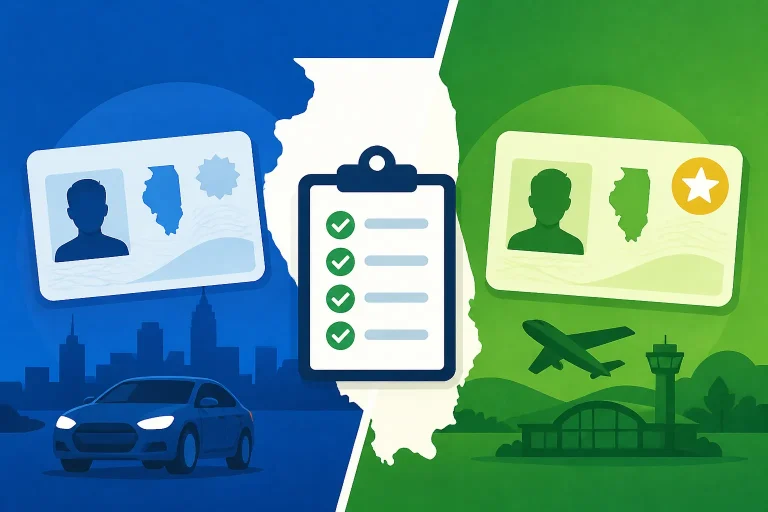
Before gathering documents, decide which type of Illinois credential you want. A standard driver’s license and a REAL ID have different document requirements, so choosing early helps you avoid preparing for the wrong application. The choice is about your identification needs; it does not change the basic requirement to apply in person as a new resident.
A standard license may be a practical choice if it meets your everyday identification needs. REAL ID may be appropriate if you want a credential designed to meet federal REAL ID standards for certain official uses. Do not choose based only on the appearance of the card or assume that a current out-of-state REAL ID automatically makes your Illinois application a REAL ID application. You still need to meet Illinois’s document requirements for the card you request.
Use the Illinois Secretary of State’s current document instructions for the exact card type you plan to apply for. Requirements can include proof of identity, residency, or other information, but the acceptable documents depend on the application and card type. Do not rely on a document list intended for a different transaction, such as a renewal or replacement. For transfer planning, Getting an Illinois REAL ID While Transferring an Out-of-State Card and New to Illinois: Applying for REAL ID During Your License Transfer address the REAL ID decision in a new-resident context.
| Your situation | What to plan for |
|---|---|
| You want a standard Illinois license | Check the current standard-license document checklist and bring the required documents to an in-person visit. |
| You want an Illinois REAL ID | Review the REAL ID document checklist separately; do not assume your out-of-state REAL ID alone meets Illinois requirements. |
| You hold a valid out-of-state driver’s license | According to the Illinois Secretary of State, you are only required to take a vision test. |
| Your out-of-state license is expired or restricted | Confirm the transfer and testing requirements for your specific status with the Illinois Secretary of State. |
| You also hold an out-of-state ID card | Be prepared to surrender it along with your out-of-state driver’s license before receiving an Illinois credential. |
The table is a planning aid, not a substitute for the agency’s current instructions. A document that proves one detail may not satisfy every requirement for the card you want. If you have a name difference between records, an unusual document, or a question about whether a particular paper is acceptable, ask the Illinois Secretary of State before your visit.
For the standard-versus-REAL-ID decision, Does Your Illinois License Meet Federal REAL ID Standards? explains the distinction. You can also compare the card types in Illinois Driver’s License Markings: REAL ID vs Standard Card.
Build a Document Checklist Before You Leave
A successful transfer visit starts with documents that match your application. The precise list depends on whether you are applying for a standard license or REAL ID and on your personal records. Use the official Illinois Secretary of State checklist for the credential you are seeking, and follow its current instructions for originals, copies, or other accepted formats.
Confirm identity and supporting records
Review the agency’s document categories and identify which documents satisfy each requirement. Avoid guessing that a single document will cover multiple categories unless the official instructions say it can. If your name has changed, or if documents use different versions of your name, check how the agency wants that difference documented. Resolving a mismatch before the visit is usually easier than discovering it at the counter.
For help understanding document categories, see Bringing Group A, B, C, and D Documents to the Illinois DMV. If you are unsure what counts as residency evidence, Acceptable Proof of Illinois Residency for a Driver’s License is a useful companion. Follow the current Illinois Secretary of State guidance if an article and the agency’s latest instructions do not match.
Separate standard and REAL ID paperwork
Do not bring a standard-license checklist and assume it is enough for a REAL ID application. The two applications can call for different evidence. If you are still deciding, first review the requirements for each, then choose one application path and organize documents for that path.
If you want a REAL ID, check whether your planned documents meet the agency’s requirements for identity and residency. A document may be useful for one purpose but not accepted for another. When a document’s role is unclear, confirm with the agency rather than bringing it as a substitute for something explicitly required.
Check names, addresses, and legibility
Compare the name and other details on your documents before the appointment. A spelling difference, a former name, or a record that has not been updated can lead to questions. If your address has recently changed, make sure the documents you plan to use meet the current residency requirements for the Illinois credential.
Bring documents in the format the agency requires, and make sure they are readable and complete. Do not alter an official document to make details appear more consistent. If you have a legitimate discrepancy, bring the appropriate supporting record and ask the agency what else is needed.
Keep the out-of-state credential available for the visit
Bring your current out-of-state driver’s license so the agency can process the transfer. If you also have an out-of-state identification card, remember that the Illinois Secretary of State requires new residents to surrender all out-of-state driver’s licenses and identification cards before receiving an Illinois license or state ID.
Because the card will not be returned as a credential to keep using, plan for identification needs after the transaction. Make sure you understand what other identification you can use for any upcoming travel, appointments, or account verification. Do not delay the transfer past the deadline simply because you have not thought through this issue; instead, prepare an alternative identification plan.
A practical way to organize the paperwork is to place the documents for the chosen card type together, keep any supporting records close by, and make a separate note of questions to ask. Before leaving, check the Illinois Secretary of State’s current checklist again. Requirements and accepted documents can change, so an old printout or advice from someone who transferred earlier may no longer be complete.
Plan the Facility Visit and Application
Once you have selected the card type and checked the documents, plan for an in-person visit. According to the Illinois Secretary of State, new residents applying for a driver’s license or ID cannot apply online and must do so “in person at a DMV.” Use the official agency’s facility locator to identify a location that handles the service you need and check its current hours, appointment rules, and service availability.
Do not rely on an old visit plan without checking it. Facility services, appointment procedures, and hours can differ or change. Confirm the current instructions through the Illinois Secretary of State, and allow enough time to complete the application and any required screening.
At the facility, expect to provide your application information, present the required documents, complete the vision test if it applies, and surrender the out-of-state credential or credentials. The Illinois Secretary of State states that the surrender happens before an Illinois license or state ID is received. If you have both an out-of-state driver’s license and a state ID, bring both and do not assume one is exempt.
The agency will explain any applicable payment, application, or issuance steps. Costs and payment options may change, so check the official source for current figures rather than relying on an old receipt, an online comment, or a past applicant’s experience. This is also a good time to ask how you will receive the Illinois credential and what temporary documentation, if any, applies to your situation.
Make sure the visit is for the correct transaction. Some tasks that sound similar—such as replacing a lost card, changing an address, renewing a license, or transferring an out-of-state credential—have different requirements. If you recently moved and are also handling vehicle paperwork, keep in mind that driver’s license and vehicle registration processes are separate. Moving to Illinois: Driver’s License and Vehicle Registration Guide can help you organize those tasks without treating them as one application.
A simple pre-visit checklist can help:
- Confirm you are within the 90-day period described by the Illinois Secretary of State.
- Check whether your current out-of-state driver’s license is valid.
- Choose a standard Illinois license or REAL ID.
- Review the official document requirements for that card.
- Gather the out-of-state driver’s license and any out-of-state ID card.
- Check the facility locator for the correct service and current visit instructions.
- Plan for identification needs after surrendering your out-of-state credentials.
If you are transferring a license along with other new-resident tasks, keep a separate list for each agency transaction. That makes it easier to spot missing documents and avoid assuming that paperwork accepted for one service will automatically work for another.
Understand What Happens to Your Old License and ID
Surrendering the old credentials is part of the transfer, not an optional final detail. According to the Illinois Secretary of State, new Illinois residents must “surrender all out-of-state driver’s licenses and identification cards” before they receive an Illinois license or state ID. The agency’s wording covers identification cards as well as driver’s licenses.
That means you should not plan to keep your former state’s ID card as a second state credential after the Illinois issuance. If you hold cards from more than one state, make a list before your appointment so you do not overlook one. Bring the cards the agency requires you to surrender, and ask the facility staff if you are unsure how a particular credential is treated.
The surrender rule is one reason to prepare before the visit. You may use a state ID for tasks that are unrelated to driving, and a license may be needed for identity checks even when you are not operating a vehicle. Arrange alternative identification for those needs before you give up the old cards. The appropriate alternative depends on the organization or service requesting identification, so confirm with that organization what it accepts.
Do not assume that keeping a photograph or photocopy of an out-of-state card will make it usable as identification. A copy may help you remember the information printed on the card, but it is not a replacement credential. If you need to preserve details for your records, make a private note or keep a copy for reference before the visit, while understanding that only the agency can tell you what it will accept during the transfer.
The process also differs from merely updating an address. An Illinois resident moving within the state may have a different transaction from a person transferring a credential from another state. If you are already an Illinois license holder and need to report a move, use How to Change Your Address on an Illinois Driver’s License Online or Updating Your Address and Replacing an Illinois License Together instead of treating that change as a new-resident transfer.
If your out-of-state credentials are lost before the transfer, do not assume the normal surrender and transfer steps can be completed in the same way. Contact the Illinois Secretary of State for instructions that fit your case. The agency can tell you what evidence it needs when the original card is unavailable.
Handle Special Cases Before Your Appointment
The standard checklist is easiest to apply when you have a valid out-of-state license, matching identity documents, and a straightforward choice between a standard Illinois license and REAL ID. If any of those conditions do not fit, check with the Illinois Secretary of State before you make a trip.
Your license is expired
The vision-test-only rule described by the Illinois Secretary of State applies to drivers moving from another state with a valid driver’s license. If your card is expired, do not assume the same rule applies. Ask the agency what testing and documentation your specific transfer requires.
An expired credential can also make it harder to show that your prior driving privilege is current. Bring any relevant official records you have and follow the agency’s instructions on how to proceed. Avoid relying on an informal statement that an expired license is “close enough” to valid.
Your license is suspended, revoked, or restricted
A suspension, revocation, or restriction can affect whether and how you can transfer your credential. A valid-license transfer rule should not be treated as a clearance of another state’s driving record. Contact the Illinois Secretary of State and explain the status accurately before you plan to drive or apply.
If you have reinstatement paperwork or official records related to your status, ask whether the agency wants them. Do not omit a restriction or assume it will not appear in a record check. Resolving status questions in advance can prevent a visit from ending with a requirement you did not expect.
You have a name or document mismatch
If your out-of-state license, identity records, and residency documents show different names or details, check the document instructions before your visit. A marriage, court order, or other name change can require supporting records, but the accepted proof depends on the agency’s current rules and your particular application.
Use Documents Needed to Change Your Name on an Illinois Driver’s License if a name change is part of your situation. For document-group questions, review Can One Identification Document Satisfy Multiple Required Groups? and confirm the agency’s current interpretation before relying on a document to satisfy more than one requirement.
You are applying for REAL ID
A current REAL ID from another state does not remove the Illinois application requirements. If you want an Illinois REAL ID, follow the Illinois Secretary of State’s document list for a new resident and verify that each document meets the correct category. If an identity or residency document is difficult to obtain, ask the agency about acceptable alternatives before you travel to a facility.
Your license is from outside the United States
This checklist focuses on transferring a license from another U.S. state. A foreign license can involve different rules, documents, and testing requirements. Do not assume that the 90-day rule or vision-test-only requirement applies in the same way. If you moved from another country, start with Relocating From Another Country: The 90-Day Window to Get Licensed or Can Temporary Visitors Drive on a Foreign Country License?, then confirm your own situation with the Illinois Secretary of State.
Frequently Asked Questions
How long do I have to get an Illinois license after moving from another state?
According to the Illinois Secretary of State, a person moving to Illinois from another state has 90 days to obtain an Illinois driver’s license or state ID. Check the agency’s current instructions and start preparing before the deadline approaches.
Can I transfer my out-of-state license online?
No. According to the Illinois Secretary of State, new residents applying for an Illinois driver’s license or ID must apply in person at a DMV.
Do I need to take a written or road test?
According to the Illinois Secretary of State, drivers moving from another state with a valid driver’s license are only required to take a vision test. If your license is expired, suspended, revoked, restricted, or otherwise not valid, confirm the requirements for your specific situation with the agency.
Can I keep my old state ID after getting an Illinois license?
According to the Illinois Secretary of State, new residents must surrender all out-of-state driver’s licenses and identification cards before receiving an Illinois license or state ID. Plan for another form of identification if you rely on those cards for other tasks.
Should I choose a standard license or REAL ID?
Choose based on your identification needs and the documents you can provide. Review the Illinois Secretary of State’s current requirements for each card type before your visit, because the required documents can differ.
Sources
- Illinois Secretary of State — Document Requirements To Obtain Drivers License Or State Id Card (checked November 11, 2026)
- Illinois Secretary of State — Newresidents (checked November 11, 2026)
Disclaimer
This article is for general informational purposes only and does not constitute professional advice. Laws, prices and regulations vary by location and change over time. Consult a qualified professional for guidance on your specific situation. Illinois Driver Guide is not a government agency and is not affiliated with any state motor vehicle department.