Commercial Driver’s License Classes in Illinois: Class A, B, or C?
A commercial driver’s license class is determined by the vehicle you’ll drive, not just your job title or the size of the truck. In Illinois, choosing between Class A, B, and C means checking vehicle weight ratings, trailer weight, passenger capacity, and hazardous-material rules. This breakdown explains what each class covers, how endorsements fit in, and what to verify before testing.
Illinois CDL classes at a glance
The first step is to identify the vehicle’s rating, then check whether it is a single vehicle or a combination. The class generally follows the vehicle’s rated weight and configuration—not how much cargo happens to be loaded on a particular trip.
| Illinois CDL class | Basic vehicle category | Trailer or passenger trigger | Common examples |
|---|---|---|---|
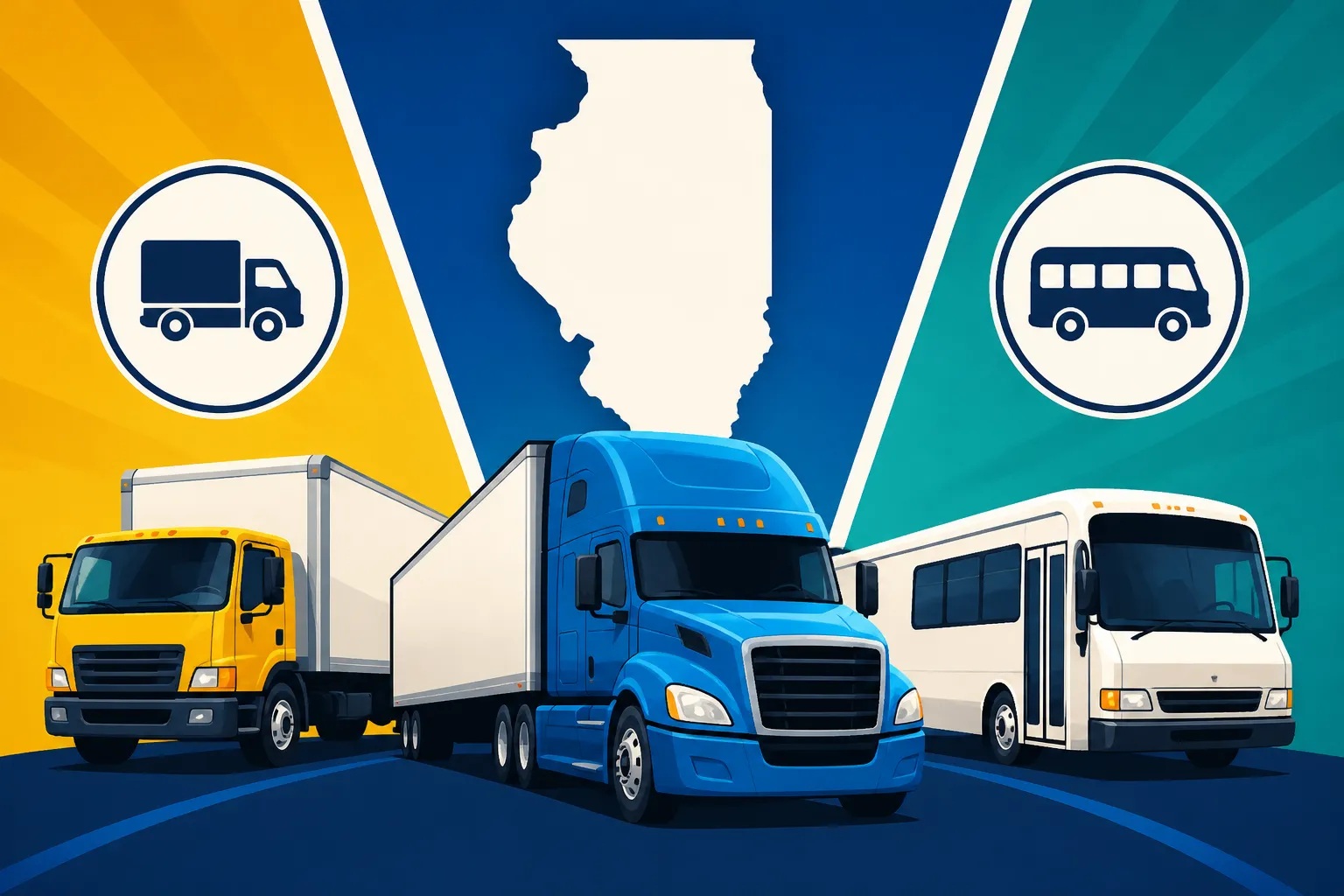
| Class A | Combination vehicle with a gross combination weight rating of 26,001 pounds or more | The vehicle being towed has a gross vehicle weight rating over 10,000 pounds | Tractor-trailer, some truck-and-trailer combinations |
| Class B | Single vehicle with a gross vehicle weight rating of 26,001 pounds or more | It may tow a vehicle rated at 10,000 pounds or less | Straight truck, many buses, some large box trucks |
| Class C | A vehicle that does not meet the Class A or B definition | It is designed to carry 16 or more people including the driver, or it transports hazardous materials that require placards | Certain passenger vans, smaller placarded hazardous-material vehicles |
These are the core federal class distinctions used for commercial licensing. The exact vehicle and the work you’ll do can add requirements, such as endorsements or restrictions. A passenger vehicle, for example, may call for a Class B or Class C license depending on its rating, but passenger service also requires the appropriate endorsement.
A useful way to remember the classes is:
- Class A: a qualifying combination vehicle, usually with a substantial trailer.
- Class B: a qualifying heavy single vehicle, with only a small trailer if one is attached.
- Class C: a qualifying passenger or placarded hazardous-material vehicle that does not meet the A or B definitions.
For an overview of testing and endorsements alongside the vehicle categories, see CDL Class Guide: Commercial Vehicles, Tests, and SOS Endorsements. For a class-focused comparison, Which Illinois CDL Class Do You Need: Class A, B, or C? is also relevant.
How to decide which class applies
Work through the vehicle details in order. The most common mistake is to focus on what a truck looks like instead of checking its official weight ratings and the weight rating of anything it tows.
Start with the ratings, not the loaded weight
Look for the gross vehicle weight rating, or GVWR, on the vehicle’s certification label and in its documentation. This is the manufacturer’s rating for the vehicle’s maximum loaded weight. It is not the same as the vehicle’s current weight on a scale.
For a combination, check the gross combination weight rating, or GCWR. This rating covers the combined vehicle and towed unit. The trailer’s own GVWR also matters when deciding whether a combination falls into Class A.
If the paperwork is unclear, ask the vehicle owner, employer, dealer, or fleet manager for the rating information. Do not estimate from the truck’s appearance, cargo capacity, or the weight of a typical load. A vehicle that is lightly loaded can still fall under CDL rules because its rating and configuration meet the definition.
Check whether there is a trailer
A large truck without a trailer may be a Class B vehicle, while a truck pulling a qualifying trailer may require Class A. The key distinction is not simply whether the driver is towing something; it is the combination’s ratings and whether the towed vehicle’s GVWR is over 10,000 pounds.
For example, a heavy single vehicle that meets the Class B threshold does not automatically become Class A when it tows a small trailer. But if the combination meets the Class A definition, the driver generally needs a Class A CDL. Check the ratings for the actual power unit and trailer rather than relying on a general description such as “delivery truck” or “work truck.”
Look for passenger or hazardous-material triggers
A vehicle that does not meet the Class A or B definition can still require a CDL if it is designed to carry at least 16 people, including the driver, or is transporting hazardous materials requiring placards. In those cases, Class C may be the relevant base class.
The passenger trigger is based on the vehicle’s design and capacity, not only how many passengers are riding on a particular trip. A vehicle designed for 16 or more people does not become a non-CDL vehicle simply because it is carrying fewer passengers that day.
For hazardous materials, the placarding requirement matters. Not every package, chemical, or regulated material automatically triggers a CDL. The material, quantity, packaging, and applicable rules determine whether placards are required. If the vehicle’s work could involve hazardous materials, confirm the requirements with the employer and the Illinois Secretary of State before applying.
Confirm whether a commercial vehicle exemption applies
Not every large vehicle is necessarily subject to the same CDL requirement. Federal and state rules include limited exemptions for certain uses or drivers. Whether an exemption applies can depend on the vehicle, its use, the driver’s role, and the type of operation.
Do not assume that a vehicle is exempt because it is privately owned, used occasionally, or driven for a small business. Recreational, agricultural, emergency, military, and other situations can involve specific rules and conditions. If you think an exemption may apply, confirm it with the Illinois Secretary of State or another appropriate official source before driving. A class decision based on a mistaken exemption can lead to licensing and employment problems.
Class A: combinations with qualifying trailers
Class A is generally the class to examine when the job involves a combination vehicle with a GCWR of at least 26,001 pounds and a towed vehicle rated over 10,000 pounds. Tractor-trailers are the familiar example, but the class is determined by the ratings and configuration rather than the name of the vehicle.
When Class A is a likely fit
Class A may be appropriate for work involving:
- A tractor and semi-trailer.
- A heavy truck pulling a large equipment or cargo trailer.
- Certain large vehicle combinations used in construction, freight, or specialized hauling.
Those examples are not a substitute for checking the ratings. Some combinations that look substantial may not meet the Class A threshold; others may qualify even if their cargo load is light. Check the GCWR and the trailer’s GVWR for the specific equipment.
A Class A license can generally cover vehicles in lower weight classes as well, but that does not remove other requirements. The driver still needs any applicable passenger, hazardous-material, tank, or other endorsement, and the license must not have a restriction that rules out the vehicle’s equipment or configuration.
What to consider before testing
The road test must be taken in an appropriate vehicle. If you test in a vehicle that does not have certain equipment or features, a restriction may be placed on the CDL. For example, testing in an automatic-transmission vehicle may limit the driver from operating a commercial vehicle with a manual transmission. Air-brake equipment and other test-vehicle features can also affect restrictions.
Ask the training provider or vehicle owner what vehicle will be used for testing and whether it matches the type of vehicle you expect to drive. A test vehicle that is convenient but not representative of the job can leave you with a license that does not cover the work you planned to do.
Some Class A applicants must complete federally required entry-level driver training before taking the applicable test. This applies to certain first-time applicants and to drivers upgrading from Class B to Class A. Confirm whether training is required for your situation and whether the provider is listed in the federal Training Provider Registry. Check the current Illinois testing process with the Secretary of State as well.
Class A does not mean every commercial vehicle
A Class A CDL is a vehicle class, not a universal permission slip. It does not automatically qualify someone to drive a school bus, transport passengers, carry placarded hazardous materials, or operate a tank vehicle. Those activities may require additional endorsements and, in some cases, additional training or testing.
It also does not guarantee that a particular employer will consider a driver qualified. Employers can set their own experience, safety, medical, and job-specific requirements in addition to the licensing rules.
Class B: heavy single vehicles
Class B generally covers a single vehicle with a GVWR of at least 26,001 pounds, or a qualifying vehicle towing a unit rated at 10,000 pounds or less. It is often the class to consider for a large vehicle that is not pulling a Class A trailer.
Typical Class B vehicles
Examples can include:
- Straight trucks.
- Some dump trucks and large delivery trucks.
- Many larger buses.
- Certain heavy utility or service vehicles.
These examples are only starting points. A bus may meet the Class B weight definition, but passenger transport can require a passenger endorsement. A school bus driver may need additional qualifications, including a school bus endorsement. A heavy truck towing a larger trailer may instead fall into Class A.
A Class B driver may be able to operate certain lower-class vehicles, subject to endorsements and restrictions. The important practical point is to check what the license allows for the exact task: vehicle type, trailer, passengers, cargo, and equipment all matter.
Class B with a trailer
A Class B vehicle may tow a vehicle with a GVWR of 10,000 pounds or less and remain within the Class B category, if the other ratings and conditions fit the definition. If the towed vehicle is rated over 10,000 pounds and the combination meets the Class A criteria, Class A may be required.
Do not decide based on the trailer’s empty weight or the load currently on it. Use its GVWR. If the trailer label is missing or unreadable, get reliable documentation before driving.
Class B and passenger work
Many buses fall into Class B by weight, but the class alone is not enough for passenger service. A driver transporting passengers in a vehicle that meets the passenger threshold generally needs the passenger endorsement. School bus work can require a school bus endorsement as well.
Passenger endorsements involve separate testing and may have requirements that differ from the basic CDL process. Confirm which endorsements apply to the specific vehicle and service. The rules can differ for a bus used for school transportation, public transit, charter service, or another purpose.
If your job involves passengers, ask the employer to identify the vehicle’s seating capacity and the endorsements required before you schedule a test. “Bus driver” does not identify one single CDL class or endorsement combination.
Class C: qualifying passenger and hazardous-material vehicles
Class C applies to qualifying commercial vehicles that do not fit the Class A or B definitions but carry at least 16 people including the driver, or transport hazardous materials that require placards. The class is less about a particular body style and more about these specific triggers.
Passenger vehicles under the A and B thresholds
A passenger vehicle that falls below the Class A and B weight definitions may still require Class C if it is designed for 16 or more people, including the driver. The passenger endorsement is also generally relevant to carrying passengers in a vehicle that requires a CDL.
For example, a passenger van may look like an ordinary large van, but its designed capacity can bring it under CDL rules. Count the driver as part of the passenger capacity when assessing the threshold. Do not use the number of occupants on a specific trip as the only factor.
The correct class can change if the passenger vehicle’s GVWR reaches the Class B threshold. In that case, the base class may be B rather than C, while the passenger endorsement remains relevant. Check the vehicle rating and seating design together.
Smaller vehicles carrying placarded hazardous materials
A vehicle can require Class C because of hazardous-material transportation even if it is not a heavy truck or large passenger vehicle. The trigger is transporting material that requires placards under applicable rules.
This is an area where the details matter. A driver should not guess based on a product name or assume that every hazardous material shipment qualifies. The applicable rules may depend on the material and shipment. Employers handling regulated materials should identify when placards are required and what license class and endorsements their drivers need.
Hazardous-material drivers may need a hazardous-material endorsement, often called an H endorsement. Applicants should expect additional eligibility checks and a separate knowledge test. The Secretary of State’s current instructions should be checked before beginning the process, because endorsement requirements and procedures can change.
Class C is not a general “small truck” license
A smaller commercial truck does not automatically need Class C just because it is used for work. If it does not meet the CDL weight thresholds, passenger threshold, or hazardous-material trigger, a CDL may not be required under the basic class definitions. Other rules, including employer policies or vehicle-specific licensing requirements, may still apply.
Conversely, a vehicle that looks like a passenger van or a small delivery vehicle can require a CDL if it meets one of the Class C triggers. Focus on the ratings, designed capacity, and cargo requirements—not the vehicle’s everyday name.
Endorsements, restrictions, and training
A CDL class tells you the general size and configuration of commercial vehicle you may operate. Endorsements add authorization for particular types of vehicles or cargo. Restrictions limit what you can drive based on the vehicle used for testing or other licensing conditions.
Common endorsements
Depending on the job, an Illinois CDL may need one or more of these endorsements:
- Passenger: for qualifying passenger-carrying vehicles.
- School bus: for school bus operation; passenger qualification may also be relevant.
- Tank: for qualifying tank vehicles.
- Hazardous materials: for transporting hazardous materials requiring the endorsement.
- Doubles and triples: for certain combinations of multiple trailers.
- Tank and hazardous materials combination: for certain work involving both types of operation.
The endorsement letters used on a license are shorthand, but the letter alone does not tell the whole story. Confirm the definition, eligibility, testing, and training requirements for the work you plan to do. Some endorsements require additional knowledge tests; others can involve skills testing or federal training requirements.
For additional preparation on written exams, see Commercial Driver Written Exams in English and Spanish and CDL Written Knowledge Test: English and Spanish Formats. To find a place for required tests, Where to Take the Illinois CDL Written and Driving Skills Tests and Finding an Illinois Secretary of State CDL Testing Facility Near You may help with planning. Confirm current testing availability and instructions directly with the Illinois Secretary of State.
Restrictions can narrow a CDL
A restriction can prevent a driver from using a vehicle feature or configuration that was not demonstrated during testing. Common examples include limits related to transmission type or air brakes. The specific restriction depends on the test vehicle and the applicable rules.
Before the skills test, ask how the vehicle’s equipment could affect the license. If the job requires air brakes, for example, make sure you understand what test and vehicle are needed to avoid an unintended limitation. If you plan to operate a manual-transmission vehicle, ask how testing in an automatic vehicle could affect your CDL.
Restrictions are different from endorsements. An endorsement adds permission for a specific operation; a restriction removes or limits permission. A driver may have the right base class but still be unable to perform a particular job because of a missing endorsement or a relevant restriction.
Entry-level driver training
Federal entry-level driver training rules apply to specified first-time CDL applicants and certain upgrades or endorsements. The rules generally cover first-time Class A and Class B applicants, upgrades from Class B to Class A, and certain first-time passenger, school bus, and hazardous-material endorsements. The training must be completed through a provider that meets the applicable requirements.
The timing differs by credential or endorsement. In some cases, training must be recorded before the skills test; for hazardous materials, it must be completed before the knowledge test. Check the current federal and Illinois requirements for your specific application rather than relying on a general course description.
Before paying for or starting training, confirm that:
- The course addresses the class or endorsement you need.
- The provider meets the applicable federal training requirements.
- Completion will be recorded through the required system.
- The course timing fits the testing sequence for your application.
Training does not replace the required Illinois knowledge or skills tests. It prepares applicants to meet the training standard and practice the relevant material.
Medical qualification and age
Commercial driving can involve medical qualification requirements. Whether and how you must document your medical status depends on the type of commercial operation and your self-certification category. Do not assume that a standard driver’s license medical history automatically covers CDL requirements. Follow the current Illinois Secretary of State process and provide any required documentation.
Age also affects the work a CDL holder may perform. Federal rules generally distinguish between intrastate and interstate commercial driving, and hazardous-material operations can have additional age requirements. Confirm both the age rules and the type of operation before investing in training or accepting a job. A license class alone does not determine whether you may drive across state lines or perform every regulated operation.
Choosing a class and completing the Illinois process
The best class is the one that covers the vehicle and work you actually intend to do. A higher class may offer flexibility, but it can also mean a different training and testing path. Avoid choosing a class only because it sounds more advanced.
A practical decision sequence
Use this sequence to narrow down the right license:
- Identify the actual vehicle. Get the make, model, vehicle configuration, and intended use.
- Read the ratings. Record the power unit’s GVWR and, if applicable, the combination’s GCWR and the trailer’s GVWR.
- Check the trailer threshold. Determine whether the towed unit is rated over 10,000 pounds and whether the combination meets the Class A definition.
- Check passenger capacity. If the vehicle is designed for 16 or more people including the driver, consider the CDL passenger rules and required endorsement.
- Check hazardous-material requirements. Confirm whether the cargo requires placards and whether an H or other endorsement applies.
- List the job’s endorsements. Include passenger, school bus, tank, hazardous materials, or multiple-trailer work as appropriate.
- Ask about restrictions and training. Find out what test vehicle will be used, whether it matches the job, and whether entry-level training applies.
- Verify with the Illinois Secretary of State. Confirm current eligibility, documents, testing steps, and facility procedures before you schedule or travel.
This process is especially helpful when an employer describes a job broadly, such as “truck driver,” “bus operator,” or “delivery driver.” Ask for the actual vehicle rating and a clear description of what you will tow, carry, or transport.
Expect knowledge and skills testing
The CDL process can include a knowledge test for the license class and additional knowledge tests for endorsements. Applicants who need a skills test are generally evaluated on vehicle inspection, basic vehicle control, and on-road driving. The test vehicle must be appropriate for the class sought.
Not every applicant takes the same tests. The requirements can depend on the license class, endorsements, prior credentials, and the reason for applying. A driver upgrading from one class to another may have different requirements from a first-time applicant. Out-of-state transfers can also involve separate rules; see Illinois Out-of-State License Transfer: Which Exams Are Required? for related information.
Before a test, confirm the required documents, vehicle condition, insurance, and any appointment or facility rules with the official agency. Do not assume that a training school’s schedule or checklist replaces the Secretary of State’s requirements. For general facility planning, Planning Your Illinois Driver Facility Visit: Complete Guide can help you prepare for an in-person visit.
Prepare with the right materials
Use the current Illinois CDL materials for the class and endorsements you plan to pursue. Study the sections relevant to general knowledge, combination vehicles, air brakes, passenger transport, hazardous materials, or other endorsements. A broad study plan is less efficient if it skips the rules that apply to the specific job.
Practical preparation should match the test vehicle too. A Class A applicant should practice the relevant combination-vehicle inspection and control tasks; a passenger applicant should prepare for passenger-specific knowledge and responsibilities. Ask the training provider or employer which vehicle will be used and what test elements apply.
If your current CDL is from another state or you already hold a different class, verify how the transfer or upgrade affects tests, endorsements, and restrictions. Procedures can depend on the credential and your record. Do not assume that holding one CDL class automatically gives you the new class or endorsement.
Verify the final class against the job
Before accepting an assignment or driving an unfamiliar vehicle, compare the vehicle’s ratings and operation with the class and endorsements on your license. Check whether a restriction affects the transmission, brakes, or vehicle type. If the vehicle changes—for example, a different trailer is assigned—the required class may change too.
An employer can help identify equipment specifications and work duties, but the legal licensing requirements should be confirmed through official Illinois and federal information. Keep a copy of vehicle-rating documentation available when the equipment is unfamiliar. If the ratings or cargo rules remain unclear, resolve the question before operating the vehicle.
Frequently Asked Questions
Is Class A always better than Class B or Class C?
Not necessarily. Class A generally covers qualifying combinations, but it does not automatically provide every endorsement or remove restrictions. The right class is the one that matches the vehicle and work, with the required endorsements added.
Does a truck need a CDL because it is used for business?
Business use alone does not determine the CDL class. The vehicle’s ratings and configuration, passenger capacity, hazardous-material requirements, and any applicable exemption are central to the decision. Other regulations may apply even when a CDL is not required.
Does a Class B CDL let me drive a bus?
Not by itself in every case. The vehicle must fit the class, and passenger service can require a passenger endorsement. School bus operation can require an additional school bus endorsement and other qualifications.
Can a Class C CDL cover hazardous materials?
Class C can apply when a vehicle that does not meet the Class A or B definitions transports hazardous materials requiring placards. The driver may also need a hazardous-material endorsement and must meet the applicable testing and eligibility requirements.
Should I choose a higher class to keep my options open?
Only if the additional class fits your goals and you can meet its requirements. A higher class does not replace endorsements, and testing in a vehicle with limited equipment may add restrictions. Confirm the job requirements and testing vehicle before deciding.
Disclaimer
This article is for general informational purposes only and does not constitute professional advice. Laws, prices and regulations vary by location and change over time. Consult a qualified professional for guidance on your specific situation. Illinois Driver Guide is not a government agency and is not affiliated with any state motor vehicle department.